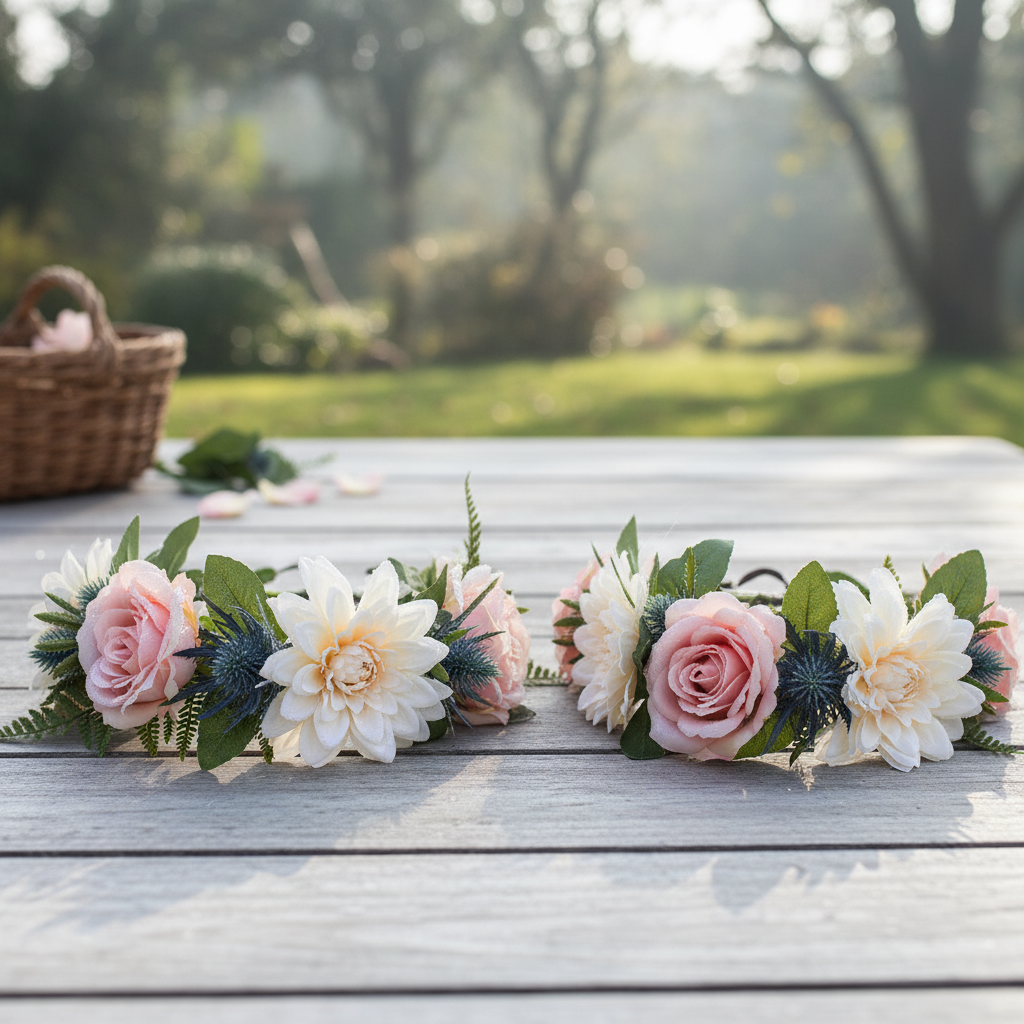
Silk vs. Fresh: Choosing Your Perfect Flower Crown Material (2026 Guide)
Key Takeaway
Silk vs. Fresh: Choosing Your Perfect Flower Crown Material comes down to a critical trade-off between the romantic authenticity of nature and the structural reliability of modern crafting. While fresh blooms offer an inimitable scent and texture, the perfect flower for an all-day event often requires the hypoallergenic durability and keepsake value of high-quality silk. This guide explores the nuances of fabric types, hydration mechanics, and cost comparisons to help you make an informed decision for your 2026 events.
Introduction
When envisioning fragrant flower blooms with dignity resting atop your head, the harsh reality of wilting petals can be a rude awakening for any bride or stylist. The quest for the perfect flower is not merely an aesthetic pursuit; it is a structural decision that impacts your budget, your comfort, and the longevity of your photographic memories. In the world of floral design, the dilemma between botanical realism and enduring structural integrity is the defining challenge for 2026 event planning.
Whether you are a bride preparing for a mid-summer ceremony, a festival-goer needing gear that survives a weekend of dancing, or a stylist curating a lookbook, the material you choose dictates the crown’s performance. Fresh flowers are living entities that require water and cool temperatures, while silk—a term now encompassing sophisticated polymers and latex—offers freedom from biology. This guide will dissect the “perfect flower” criteria: weight distribution, wilt-resistance, and aesthetic flow, ensuring your headpiece remains a crowning glory rather than a wilting burden.
Author Credentials
By the Design Team at [Brand Name]. Specializing in handmade fascinators and floral design mechanics. Content reviewed by Certified Florists. Last updated: 24 February 2026.
What is Silk vs. Fresh: Choosing Your Perfect Flower Crown Material? Definition & Overview
To understand the debate, we must first define the biological concept of a complete perfect flower versus the aesthetic ideal we strive for in design. In botany, a “perfect flower” is a specific term referring to a bloom that contains both male (stamen) and female (pistil) reproductive structures. However, in the context of luxury headwear, the “perfect flower” is defined by its ability to maintain turgidity (water pressure) and color vibrancy under stress.
Fresh Flowers are living plant tissues. They are ephemeral, relying on a continuous chain of hydration and temperature control to look their best. From the moment a stem is cut, it begins a process of senescence (aging). For a flower crown, this means the clock is ticking the moment the florist wires the stem. Historical context shows us that ancient Greek laurel wreaths were the precursors to modern crowns, celebrating the fleeting nature of victory and life. For more on this evolution, consult resources on Modern Floral Design History.
Silk Flowers, conversely, are permanent botanicals. The term “silk” is an industry catch-all. Modern replicas are rarely made of actual silk, which frays easily. Instead, we see high-end polyester blends, latex-coated fabrics (Real Touch), and 3D-printed polymers. These materials allow designers to manipulate flower types that would otherwise be impossible to wear. For example, a lotus flower is aquatic and collapses instantly out of water, but a polymer replica captures its aquatic elegance without the biological requirements, allowing for designs that defy nature’s laws.
Why the Material Matters: Longevity, Aesthetics, and Comfort
Imagine attempting to wear a delicate skeleton flower (Diphylleia grayi) in a fresh crown; its petals turn transparent and dissolve upon contact with moisture, making it a disastrous choice for a humid wedding but a stunning option in silk. We all desire fragrant flower blooms with dignity, yet the practical implications of material choice extend far beyond the visual. The impact on photography is profound; fresh white petals can brown at the edges within hours in 80°F heat, showing up as “bruised” in high-resolution photos. Conversely, low-quality synthetic fabrics can reflect camera flashes, creating a plastic sheen.
Allergies and scent are also critical factors. A fresh garden rose crown provides a sensory experience that perfume cannot replicate, but it also invites hay fever risks for the wearer and guests. Furthermore, sustainability is a growing concern for the 2026 consumer. Fresh flowers often carry a heavy carbon footprint due to international refrigeration and air travel. While synthetic flowers are often plastic-based, their reusability offers a different kind of sustainability. A “perfect flower” in this context is one that balances environmental impact with personal utility. For insights into material textures, see The Plush Pleasure of Velvet, which parallels the rise of velvet-texture “Real Touch” roses.
Finally, currency and budget play a role. While high-end faux botanicals can cost more per stem than fresh equivalents, the labor cost for fresh crowns is significantly higher due to the need for cold storage and last-minute assembly.
How It Works: The Anatomy of Fresh Blooms vs. Botanical Replicas
Constructing a sturdy flower crown with flowers that stay in place requires a deep understanding of floral mechanics and the creation of a balanced flower mound. The engineering required for fresh versus silk is vastly different, primarily due to weight and water.
The Science of Fooling the Eye
High-end replicas utilize advanced textile manufacturing. “Real Touch” flowers are made by coating foam or fabric in latex, giving them the cool, damp feel of a living petal. This is essential for the “perfect flower” illusion. Cheaper alternatives use basic polyester, which lacks the microscopic texture of natural plant epidermis. When selecting materials, you are looking for “botanically correct” stamens and irregular petal edges, which signal high quality.
Fresh Mechanics: The Hydration Challenge
Fresh flowers in crowns have no water source. To create a perfect flower crown with fresh materials, florists use a technique called “taping and wiring.” Each stem is cut short (1-2 inches), wrapped in wet cotton or floral tape, and then wired onto a main structural wire. This adds significant weight. A fresh rose crown can weigh upwards of 1-2 pounds, depending on density. The florist must spray the finished piece with a cellular sealant (like Crowning Glory) to lock in moisture. For detailed mechanics, refer to Floral design guides.
Structural Integrity and the 3:5-8 Rule
Whether silk or fresh, professional designs often follow the 3:5-8 rule, derived from the Fibonacci sequence. This design principle dictates the placement of focal flowers to create a natural flow.
- 3 Focal Flowers (large blooms like Peonies)
- 5 Secondary Flowers (Roses or Ranunculus)
- 8 Filler accents (Waxflower or Berries)
In silk, this balance is easier to achieve because the wire stems are lightweight and flexible. In fresh designs, placing three large peonies on one side can cause the crown to slip due to the water weight in the flower heads. The “perfect flower” for a crown is often one with a high petal count but low water weight, such as a dehydrated or dried variety, or a high-quality silk replica that mimics the volume without the mass.
Silk vs. Fresh in Practice: Examples & Applications
Real-world scenarios dictate whether you should choose a lotus flower replica or a fresh garden rose. Let’s examine specific case studies where the “perfect flower” choice changes based on the environment.
Scenario A: The Destination Wedding
If you are traveling to a tropical location, silk is the superior choice. Customs regulations often prohibit bringing fresh plant matter across borders. Furthermore, tropical heat accelerates wilting. A bride wanting a crown of delicate skeleton flower replicas can pack them in a suitcase without fear of crushing, provided they are boxed correctly. The “perfect flower” here is one that travels well.
Scenario B: The Spring Garden Party
For a local event in mild 60°F weather, fresh flowers offer unmatched texture. The natural variation in a fresh bloom—the way a petal curls or the slight imperfection in color—adds a layer of luxury that is hard to fake. Here, the perfect flower might be a fresh Spray Rose or Lisianthus, which hold up reasonably well out of water.
Case Study: Impossible Botany
Silk allows for “impossible botany”—combining flowers that do not bloom in the same season or habitat. You can pair a spring Tulip with an autumn Dahlia. You can also utilize flowers that are physically impossible to wire fresh, such as the lotus flower. A fresh lotus has a hollow, thick stem that crushes when wired and petals that bruise instantly. A high-quality silk lotus retains its shape and serves as a dramatic, architectural focal point in a crown.
Handmade With Love: Labor Comparisons
Creating a fresh crown is a race against time. It must be made the morning of the event. A silk crown, however, is a work of art that can be crafted months in advance. This allows for multiple fittings and adjustments, ensuring the perfect flower placement for your hairstyle. For more on the artistic process of floral crafts, see How To Make Flower Fairies.
Getting Started with Your Selection
Selecting the right flower types without losing your mind requires a systematic approach. Before you even consider flowers foods or hydration sprays, you must validate the feasibility of your vision.
The Ultimate Showdown Checklist
- Assess the Climate: Is it over 75°F? If yes, lean towards silk or hardy fresh flowers (like orchids or mums).
- Duration of Wear: Do you need the crown for 2 hours (ceremony) or 10 hours (full festival)? Fresh flowers are generally good for 4 hours max without a water source.
- Activity Level: Will you be dancing? Silk crowns can be secured more tightly and are lighter, reducing the “bobble” effect.
Step-by-Step Selection
Start by requesting samples. For silk, order single stems to check the fabric quality. Does it fray? Does it look plastic under flash photography? For fresh, ask your florist for a “mockup” boutonniere to see how the specific variety holds up out of water. Do not rely on flowers foods to save a crown; these solutions are for vase water, not for misting finished headpieces.
Identify your “perfect flower” candidates. If you love Hydrangeas, know that they are the first to wilt (often within 30 minutes). A silk Hydrangea is a “perfect flower” substitute that provides the volume without the tragedy. Research cited in Research Study 1 suggests that material satisfaction is directly linked to expectation management regarding durability.
Common Mistakes & How to Avoid Them
One of the most tragic aesthetic errors is the “broken flowers” look, where a crown begins to droop halfway through an event. Unlike the melancholic beauty found in flowers lyrics regarding lost love, a wilting crown on a bride simply looks messy.
Mistake 1: Ignoring Weight
Fresh flowers are 80-90% water. A crown fully loaded with fresh peonies is heavy and can cause headaches. The “perfect flower” arrangement balances weight distribution. Avoid placing all heavy blooms on the front; distribute them to the sides.
Mistake 2: The “Broken Flowers” Effect
Choosing fragile varieties like Poppies, Sweet Peas, or Anemones for a fresh crown is a mistake. These have thin petals that dehydrate rapidly. Always choose sturdy “perfect flower” candidates like Spray Roses, Orchids, or Chrysanthemums for fresh designs.
Mistake 3: Mixing Qualities
If you choose to mix silk and fresh (a hybrid approach), do not mix high-quality fresh blooms with dollar-store silk. The contrast in texture will destroy the illusion. Use “Real Touch” silk alongside robust fresh greenery for the best result. As noted in fashion critiques like The Hard Slog of Keeping a Vision, consistency in material quality is key to a cohesive look.
Frequently Asked Questions
What is the difference between silk and fresh flowers?
Fresh flowers are living, fragrant, and ephemeral, requiring cool conditions and hydration. Silk flowers are permanent, hypoallergenic replicas made from polyester, latex, or polymers. The “perfect flower” choice depends on whether you prioritize tradition and scent (fresh) or durability and keepsake value (silk).
Are flower crowns still in style in 2025-2026?
Absolutely. The trend has shifted from the massive bohemian festivals halos to more structured, architectural designs resembling fascinators. The flower crown with flowers that mimic royal tiaras or asymmetrical fascinators is a top trend for 2026.
What is the 3:5-8 rule in flower arrangement?
The 3:5-8 rule is a design principle based on the Golden Ratio (Fibonacci sequence). It suggests using odd numbers of materials to create dynamic visual interest. In a crown, you might use 3 focal blooms, 5 supporting blooms, and 8 accent sprigs to create a balanced flower crown with flowers that leads the eye naturally across the piece.
What flowers to pick for a flower crown in FF7 Rebirth cosplay?
For fans replicating Aerith’s iconic look from Final Fantasy VII Rebirth, structural integrity is key for conventions. The “perfect flower” for this is a silk Lily or a hardy fresh Easter Lily. Avoid fragile blooms. You want a flower crown with flowers that can withstand the heat of a convention center and the weight of a wig. Silk is highly recommended for cosplay to ensure the costume looks pristine in every photo.
Can you mix silk and fresh flowers?
Yes, this is a “hybrid” technique. Often, florists use a base of fresh, hardy greenery (like Ruscus or Eucalyptus) which lasts a long time out of water, and insert high-quality silk focal flowers (like Peonies) to keep the weight down and prevent wilting. This offers the smell of fresh greens with the durability of silk blooms.
Conclusion & Next Steps
Silk vs. Fresh: Choosing Your Perfect Flower Crown Material is a decision that shapes the memory of your event. If you crave the romance of fleeting beauty and the scent of nature, fresh botanicals are your path—provided you choose hardy varieties. If you prioritize stress-free durability, lightweight comfort, and a permanent keepsake, silk is the superior choice.
Ultimately, the perfect flower is the one that aligns with your specific needs. Do not let tradition dictate your comfort. We encourage you to order samples of “Real Touch” blooms or consult with a florist about hybrid options. Whether you choose the biological authenticity of a garden rose or the engineered perfection of a polymer orchid, ensure your perfect flower selection is one that allows you to celebrate without worry.